



HIIT training: studies, benefits and experiences
Research – especially in German-speaking countries – underpins the diverse health benefits of HIIT training, from improved cardiovascular health and efficient fat burning to mental benefits. At the same time, HIIT impresses with its effectiveness compared to conventional training methods and its appeal for people with little time. For personal trainers in Switzerland and the DACH region, HIIT offers a scientifically sound, motivating, and flexible way to guide clients to rapid and lasting success. So, anyone looking for a workout that is both time-saving and effective can hardly ignore HIIT training – true to the motto: "Short, sharp, and full of power," but with long-term benefits.
HIIT training explained by a professional (doctor): VIDEO 📹
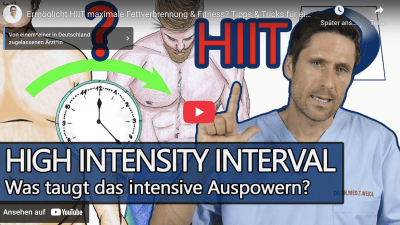
We thank DoktorWeigl for this insightful, practical video.
Health benefits of HIIT training 🏃♂️🔥
A large meta-analysis (summarizing 33 systematic reviews) comprehensively confirmed the positive effects of HIIT training on health. It found that HIIT significantly improves cardiorespiratory fitness and cardiovascular function—among other things, through an increase in maximum oxygen uptake (VO₂max) and adaptations in the heart muscle. At the same time, HIIT training has a positive effect on body composition : It reduces body fat and can even promote muscle building in beginners. In a 12-week study with overweight young men, participants lost an average of 2 kg of fat mass and simultaneously gained about 1.1 kg of lean mass (muscle). Unlike longer endurance training, HIIT does not lead to muscle loss—on the contrary, it helps maintain muscle, which is beneficial for metabolism.
Cardiometabolic health markers can also be improved through HIIT training. Researchers at the University of Erlangen (FAU) developed a particularly time-efficient protocol ("low-volume" HIIT: only 2 x 14 minutes per week), which has been successfully tested in several studies. In overweight subjects with metabolic syndrome, a 12-week program not only led to increased endurance performance and a significant reduction in blood pressure, but also to improvements in liver health – an existing non-alcoholic fatty liver disease significantly regressed. Doctors also observed an anti-inflammatory effect : HIIT training reduced chronic inflammatory markers in the blood so significantly that the effects were similar to drug therapy. Positive effects were even observed in patients with serious illnesses . In the FAU study, the 14-minute HIIT training proved safe and feasible even for people with advanced cancer. After twelve weeks of HIIT, these patients increased their cardiac fitness, felt less fatigued, and experienced increased activity of their natural killer cells—important immune cells for fighting tumor and viral cells.
Last but not least, mental health also benefits from HIIT. In addition to the well-known mood-enhancing effects of exercise (keyword: endorphins), studies point to specific advantages. The aforementioned meta-analysis documented significant improvements in mental health through HIIT in both healthy individuals and those with existing health problems. For example, recent studies suggest that HIIT training can improve cognitive functions such as memory in old age – HIIT training apparently sustainably increases the performance of the hippocampal area of the brain. Importantly, no study has yet been able to demonstrate negative psychological effects of HIIT. In summary, HIIT is considered a safe and effective method for promoting physical and mental health. Neither an increased risk of injury nor other adverse effects have been observed compared to more moderate training.
Effectiveness compared to other forms of training 🏋️♀️🧘♂️
A key argument for HIIT is the time savings it offers , with comparable (or even better) results compared to traditional endurance training. Studies have shown that even short, intense interval training sessions produce similar performance gains to significantly longer sessions at moderate intensity. An impressive example is the German RUSH study , in which 81 untrained men (30–50 years old) completed either 16 weeks of HIIT running training or moderate continuous endurance training (medium intensity, “MICE”). Both groups improved their endurance performance (time to exhaustion in the step test) by almost the same amount, by approximately 27–29%. However, maximum oxygen uptake (VO₂max) increased almost twice as much in the HIIT group as in the moderately trained group (+14.7% vs. +7.9%). The HIIT participants therefore achieved greater cardiovascular adaptations in the same training time. Moderate endurance training, however, led to slightly better running economy (economy of movement)—an expected finding, as continuous training tends to improve efficiency, while HIIT training primarily increases maximum power reserves. The bottom line is that both methods are comparably effective for endurance in the initial phase, but work through different mechanisms.
HIIT training also performs excellently compared to traditional forms of training in terms of calorie consumption and fat loss . A study in the Journal of Strength & Conditioning Research compared the calorie consumption of test subjects who each completed different workouts for 30 minutes: HIIT, strength training, moderate running, or cycling. The result: The HIIT group burned up to 30% more calories than the other groups – even though the effective exercise time within the 30 minutes was only about a third due to the breaks. Extrapolated, this means that just 15 minutes of HIIT can achieve roughly the same calorie consumption as 60 minutes of steady-state endurance training on the treadmill. This extreme efficiency makes HIIT particularly attractive for anyone looking to lose weight or reduce their body fat percentage. In addition, the so-called afterburn effect (EPOC) following intense intervals ensures that the body has an increased metabolism and burns additional calories for hours after HIIT training. Studies confirm that HIIT keeps your metabolism elevated for up to two hours post-workout, meaning you continue to burn fat even after your workout. Compared to longer endurance training, HIIT also protects your muscles (no muscle breakdown), which benefits your basal metabolic rate in the long run. All of these factors explain why HIIT workouts are superior to many traditional methods in terms of training results per unit of time.
Motivation and suitability for everyday life ⏱️✅
A common reason why people don't exercise enough is a lack of time . This is where HIIT plays its biggest trump card: time efficiency. The World Health Organization recommends 150 minutes of moderate exercise per week - a sensible goal, but one that many people don't achieve in their hectic everyday lives. This is precisely where HIIT comes in. Sports scientists at FAU Erlangen emphasize that short, intensive programs have been developed "that are considerably more time-efficient, but still offer health benefits." In their studies, with just 2 x 14 minutes of exercise per week, significant improvements were achieved in a wide variety of health parameters, as described above. For working people and people with tight schedules, it is motivating to know that just 15-30 minutes of effective HIIT training is enough to make progress. According to experts, one of the key advantages of HIIT is that exercisers "enjoy the same health benefits as with a longer, less intensive workout" - and in a fraction of the time. This knowledge can significantly increase the motivation to start training at all.
Another advantage of HIIT is its practical feasibility . The short intervals can be flexibly integrated into everyday life—whether in the morning before work, during your lunch break, or in the evening at home. HIIT exercises often require little or no equipment (e.g., sprints, burpees, jump rope), making HIIT training possible at home or outdoors. Interestingly, even certain groups of people can successfully complete HIIT: In a Swiss study with geriatric rehabilitation patients (average age 82), HIIT was tested on a stationary bike. 82.4 % of all planned units could be carried out, the adherence (participation rate) was 83.3 % – an indication of its feasibility even at an advanced age. The seniors achieved significant improvements in their endurance performance (measured as oxygen uptake) through HIIT and reported increased performance and quality of life. This result demonstrates that HIIT training – with expert guidance – can be adapted to individual abilities from young to old. Acceptance of the training was high, suggesting that short, varied intervals can also have a long-term motivating effect.
Last but not least, HIIT training is fun : The intervals are challenging and offer variety, which helps prevent boredom. Many exercisers appreciate the feeling of pushing themselves to their limits and then feeling the recovery afterward – this constant change can increase the desire to train. A practical experiment in Germany underscored the motivating effects of HIIT: A group of novice athletes completed a HIIT program twice a week for four weeks. At the end, over 80 % of participants reported feeling more efficient and fitter than before; almost 70 % wanted to permanently integrate HIIT into their daily routine and continue to stay physically active. This feedback is consistent with the experience of many coaches that results are often noticeable more quickly with HIIT – which greatly boosts training morale. In short: The prospect of measurable results in a short time and the versatility of HIIT make it an extremely suitable and motivating form of training for many people.
HIIT im Personal Training 💡
HIIT training plays an important role in personal training . Year after year, HIIT ranks at the top of the trend list in surveys among fitness professionals. In Europe, according to an ACSM survey for 2024, HIIT was even ranked as the second most important fitness trend – right behind personal training itself. This combination is no coincidence: personal training and HIIT complement each other perfectly. Many clients want time-saving workouts with maximum effect, and this is precisely where a personal trainer can score points with HIIT training. Through individually tailored, intensive intervals, excellent results can be achieved in 30-minute PT sessions, for example, without the need for hours of workouts. HIIT is also extremely versatile – a qualified HIIT trainer can tailor interval training to the client's fitness level and goals, whether it be weight loss, improved stamina, or metabolism boosting. Supervision and guidance from a HIIT trainer plays a key role: This ensures that the exercises are performed with proper technique and at an appropriate intensity. This minimizes the risk of injury and ensures training success. Experts emphasize that while HIIT is suitable for almost all target groups, "attention must be paid to adequate implementation" – a criterion where personal trainers contribute their expertise.
Practical success stories demonstrate how effective HIIT can be in personal training. In Switzerland, numerous trainers rely on HIIT to help their clients achieve noticeable progress in a short period of time. The trainer network TRAINORS explicitly promotes HIIT as a method that "boosts fat burning and increases performance" – and many individual experiences confirm this. A concrete case study: In just four weeks of two HIIT sessions per week, beginners in a test program increased their strength endurance (plank hold time) by almost 46% and their aerobic endurance (12-minute Cooper test) by over 8%. Over 80% of participants felt fitter overall afterward and were so satisfied with their progress that they wanted to continue HIIT as a regular part of their training. Even older clients have achieved remarkable success under professional supervision – as studies at the rehabilitation center and at FAU have shown, significant improvements in fitness and well-being are possible through HIIT training, even for seniors or those with underlying health conditions. Such successes spread and contribute to the continued popularity of HIIT in personal training.
Frequently asked questions about HIIT training ❓🏃♂️
1. Is HIIT good for losing weight?
High-intensity interval training (HIIT) has become one of the most popular forms of training in recent years. Numerous studies and practical reports have been published, particularly in the DACH region (Germany, Austria, and Switzerland), that impressively demonstrate the diverse benefits of HIIT training. HIIT is characterized by alternating phases of very intense exercise and active recovery. Despite the relatively short workouts, maximum calorie burn and rapid performance improvements are achieved.
2. Is HIIT really that effective?
The abbreviation HIIT stands for High Intensity Interval Training . It alternates very intense phases of exercise (e.g., sprints or burpees) with short recovery breaks. This method quickly pushes the body to its limits – and that's precisely what makes it so effective. The principle: short, intense, efficient .
3. What is the HIIT method?
Yes – HIIT training is excellent for weight loss . The high intensity burns a lot of energy in a short period of time. Additionally, the so-called afterburn effect ensures that calories are burned even after the workout. Studies show that HIIT often burns more fat than longer, moderate exercise , especially in the abdominal area.
4. Which exercises are used in HIIT?
Typical HIIT exercises are:
-
Burpees
-
Jumping Lunges
-
Rope skipping
-
Mountain Climbers
-
High Knees
-
Sprints (also on a bike or cross trainer)
-
Start HIIT training with a personal trainer now. Find the right coach here or use our search service. Start here now ✅
 Bottom line: High-intensity interval training is much more than a short-lived fitness trend.
Research – especially in German-speaking countries – underpins the diverse health benefits of HIIT training, from improved cardiovascular health and efficient fat burning to mental benefits. At the same time, HIIT impresses with its effectiveness compared to conventional training methods and its appeal for people with little time. For personal trainers in Switzerland and the DACH region, HIIT offers a scientifically sound, motivating, and flexible way to guide clients to rapid and lasting success. So, anyone looking for a workout that is both time-saving and effective can hardly ignore HIIT training – true to the motto: "Short, sharp, and full of power," but with long-term benefits.
Absolutely. Numerous studies from Switzerland and Germany confirm that HIIT training increases endurance, promotes fat burning, and improves cardiovascular health – while requiring significantly less time than conventional training. Just two to three sessions per week can produce noticeable results.