
Pilates training for health and mobility
Pilates is a holistic training method that specifically improves strength, flexibility, and body awareness. It's gentle yet effective: Just two Pilates sessions per week can significantly relieve chronic back pain, for example—as long as you stick with it regularly.
In short: Pilates is good for both body and mind . Below, you'll learn why this is so, the benefits of a Pilates instructor, and how you can achieve your goals with personalized training. Have fun on your journey to greater health and flexibility!
Pilates Review: Is it really a cure-all? VIDEO 📹
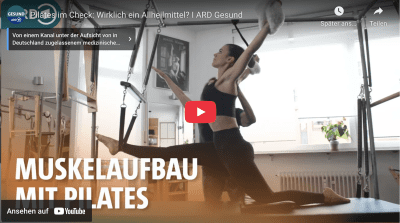
We thank ARD and Pilates trainer Davorka Kulenovic for this informative video.
Good reasons for Pilates 🌟
Pilates has countless benefits. We've picked out four good reasons why Pilates training is worthwhile for you – from health to mental health :
- Health: Pilates strengthens the core muscles and improves posture, which helps prevent back problems. Many exercises activate the deep abdominal and back muscles, as well as the pelvic floor – a strong core protects the spine and can relieve back pain. Pilates also stimulates circulation and strengthens the immune system. Doctors report that, with regular practice, Pilates can noticeably improve chronic back pain. In short: your health will thank you with less pain and greater well-being (pure Pilates health !).
- Flexibility: Flowing stretching and strengthening exercises make muscles and joints supple . Pilates increases flexibility and improves range of motion without the need for strenuous stretching after training—the exercises combine strength and stretching simultaneously. The result: better mobility in everyday life and a lower risk of injury. Even your sense of balance benefits enormously: Studies show that Pilates improves balance and prevents falls, especially in older people. Pilates allows you to move through life more safely and easily .
- Mental strength: Pilates is a balm for the psyche. Through the calm, concentrated movement and deep breathing, the body switches from stress mode to relaxation mode. The nervous system is calmed, and stress hormones like cortisol decrease. Many practitioners report inner peace and better sleep – in fact, studies have shown improvements in sleep quality. Mood also improves: Pilates reduces anxiety and depressive symptoms and promotes greater mindfulness in everyday life. In short, Pilates reduces stress and promotes a positive, balanced mood. A workout that will leave you smiling as you leave the mat!
- Holistic & individual: Pilates knows no age or limit – everyone from beginners to professionals can benefit. The exercises are incredibly adaptable : intensity and complexity can be adjusted to your fitness level and any limitations. Whether young or old, whether you're a sports fanatic or an athlete – Pilates meets you at your level. This versatility makes Pilates equally attractive for beginners and advanced students and promotes health at any age. Want to start gently or really push yourself? Both are possible, because Pilates is individually scalable. A true all-rounder!
What is trained in Pilates? 🤸
Pilates is a full-body workout that pursues multiple goals simultaneously: strengthening , stabilization , stretching , and coordination . The core of the body —often referred to as the powerhouse —is at its core, meaning the abdomen, lower back, and pelvic floor. This core training forms the foundation for a strong body and improves posture. But Pilates trains much more than just the abdomen:
- Core and back: Exercises like the bridge or plank strengthen the entire core muscles. This stabilizes the spine and can prevent posture problems. A strong core supports all daily movements.
- Legs and buttocks: Many Pilates exercises involve the legs and buttocks – for example, Pilates-style leg circles or lunges . This strengthens the leg muscles, tones the buttocks, and improves hip mobility. The result: more stability when walking and a reduced risk of falls as you age.
- Shoulders and arms: The upper body doesn't get neglected either. Plank exercises (like the side plank ) strengthen the shoulders and arms using your own body weight. At the same time, they improve upper body posture and prevent tension.
- Balance and coordination: Typical Pilates exercises train balance—such as exercises on one leg or with closed eyes—and improve body coordination. This benefits you in all your everyday movements.
Breathing is also an important component of Pilates. In almost every exercise, you learn to breathe consciously . Deep Pilates breathing increases oxygen supply to the muscles and helps harmonize movement and breathing. This makes even small movements more effective.
Typical Pilates exercises: Classics include the "Hundred, " a dynamic breathing exercise for abdominal endurance, the shoulder bridge for back and legs, and the side plank to strengthen the lateral body muscles. Exercises like the roll-up (spinal roll) and the swan (back extension) are also included. Don't worry—a good Pilates instructor will guide you step by step through these exercises. What matters is not the number of repetitions, but the control and precision of each movement.
Why a Pilates trainer makes sense 😊
Sure, there are books and online videos, but hiring a personal Pilates trainer has unbeatable benefits. Here are the top reasons why personal trainers make Pilates so effective:
- Individualized support: In one-on-one Pilates training, you are the focus. The instructor will create a customized training plan tailored to your goals, your body type, and any health restrictions. This personalized Pilates support ensures that you are neither over- nor under-challenged. Every step of your progress is based on a plan specifically designed for you —providing security and maximizing your success.
- Correct Execution & Safety: A trained Pilates instructor pays meticulous attention to correct technique . They correct poor posture, provide hands-on support, and ensure that you perform the exercises cleanly and safely . This prevents injuries and optimizes the effect of each exercise. Pilates, in particular, which requires precise alignment and breathing, requires guidance at the beginning. With a Pilates instructor, you can avoid common mistakes right from the start and learn Pilates correctly .
- Motivation and persistence: Hand on heart – I'd rather skip training at home alone . A Pilates trainer, on the other hand, provides motivation : fixed appointments, personal attention, and a constant flow of new exercises. Your trainer knows your goals and encourages you to stick with it. Small successes are celebrated, and slumps are overcome together. This coaching gives you the necessary incentive. You'll stay more consistent when you have a professional at your side, supporting and challenging you.
- Expertise & Experience: A certified Pilates trainer has extensive expertise in anatomy, training theory, and often also nutrition or rehabilitation. You'll benefit directly from this. If you have any problems (e.g., back or knee problems), the Pilates trainer knows which exercises are suitable or need to be adjusted. They can answer your questions , clarify any uncertainties, and use their experience to anticipate typical hurdles during training. This expertise gives you confidence and makes your training more effective – you'll reach your goals faster and more sustainably than if you were to experiment on your own.
In short: A Pilates instructor is a coach, motivator, and safety net all in one. The investment is particularly worthwhile for beginners to lay a solid foundation. But advanced practitioners also benefit from new inspiration and professional guidance on their way to the next level.
A Pilates trainer corrects posture and adapts the exercises individually – for maximum success and safety during training.
Training forms & implementation 🧘
Pilates training with a personal trainer can be very flexible. Depending on your preferences and lifestyle, various training formats and locations are available:
- Private training at home: Many Pilates instructors come directly to your home. Pilates doesn't require much space—a mat is sufficient for most exercises. Pilates at home offers the advantage of being in a familiar environment and saving time. The instructor may bring small equipment (balls, bands), and you enjoy one-on-one support without an audience. Perfect for those who want to practice privately and flexibly.
- One-on-one training in the studio: Some personal trainers offer private studios or work in Pilates studios/fitness centers. These often have specialized Pilates equipment (Reformer, Cadillac, Barrel) available to enhance your workout. In the studio, you have full facilities and absolute peace and quiet. Your trainer can use professional equipment to increase the intensity or target specific muscle groups, for example. Ideal if you want the complete Pilates experience .
- Pilates group lessons: As an alternative to purely individual training, many instructors also offer small group sessions – such as duo or trio training with friends, or open small groups of up to four people. In these group lessons, you benefit from the group dynamic, share the costs, and still receive more individual attention than in large studio classes. While individual Pilates training remains the most exclusive option, small groups offer fun and mutual motivation. It's important that the group matches in terms of skill level – your instructor will ensure this.
- Online training: Pilates via Zoom and other platforms is becoming increasingly popular these days. Your personal trainer instructs you via video while you practice on the mat at home. This format allows for location-independent training—perfect if your chosen Pilates instructor is in another city or if you travel frequently. Despite the distance, the instructor can still see you and correct you. Online coaching is a practical option for Pilates at home , as long as you have basic knowledge and the camera is well positioned.
- Outdoor Pilates: Fancy some fresh air? Some instructors also offer outdoor Pilates classes in the summer—for example, in a garden or park. This can be a great way to work on flexibility in the open air (weather permitting, of course 🌦️). Feel free to ask your instructor about these options if you enjoy being outdoors!
Training locations in Switzerland: Whether in Zurich, Basel, Bern, or the countryside – Pilates is booming in Switzerland . There are studios and qualified trainers everywhere. On our platform, you'll find experts who are mobile and make home visits, as well as trainers with fully equipped studios. The important thing is: Choose the training format you feel most comfortable with. Only then will you stay with it and enjoy it!
Myths & mistakes in Pilates – what's really true? 😉
There are several myths surrounding Pilates, and beginners sometimes make common mistakes . Let's clear up a few misconceptions:
- ❌ Myth: "Pilates is only for women." Truth: Pilates was developed by Joseph Pilates (a man!) and originally taught to soldiers during the war as a rehabilitation exercise. Today, men and women benefit from Pilates just as much – many elite athletes (footballers, runners, etc.) use Pilates to improve core strength and flexibility. In short: Pilates is for everyone , regardless of gender or age.
- ❌ Myth: "Pilates is too easy for me, it's just stretching." Truth: It's not easy at all! What looks simple at first glance can be quite challenging when performed correctly. Pilates workouts will make even fit people sweat, just without dumbbells or high-intensity jumping. It's about control rather than momentum . Anyone who has tried Pilates knows: The slow movements really burn your muscles. Pilates combines strength training with flexibility – definitely more than just stretching.
- ❌ Myth: "Without expensive equipment, Pilates is useless." Truth: Sure, the famous Pilates equipment like the reformer looks impressive. But classic mat Pilates is just as effective. Pilates exercises on the mat use your own body weight and maybe the occasional ball or band—that's all you need. Equipment can complement and vary your workout, but it's not required. You can practice Pilates anywhere , even without a studio. Success depends on the right technique, not on fancy equipment.
- ⚠️ Common mistake: Ignoring your breathing. Correction: Pilates has a specific breathing technique (in through the nose, out through the mouth, ribs expanding) that is part of the exercise . Beginners tend to hold their breath. Better: Breathe consciously! Breathing helps you find rhythm and focus – and supplies the muscles with oxygen, making your workout more effective.
- ⚠️ Common mistake: Fast, faster, done! Correction: Pilates is not a race. If you do the exercises too quickly, you're using momentum instead of muscle power. The result: less effect and a higher risk of injury. Slow and controlled is the motto. Quality over quantity – perform each repetition consciously, keep it clean, and pay attention to your core tension. Your body will thank you with real progress.
- ⚠️ Common mistake: Trying too hard and then giving up in frustration. Correction: Pilates beginners, in particular, are sometimes surprised to find it's more challenging than they thought. Don't be discouraged! The key is to stick with it and be patient. The results—better posture, stronger abdominal muscles, less tension—will come with regular practice. Focus on continuous improvement rather than perfection in the first month. Every day on the mat is a step forward. And remember: Your trainer is there to support you.
Practical tips for getting started with Pilates ✨
Are you motivated to start Pilates? Excellent! These practical tips will help you get started – so you can stay on track and get the most out of your Pilates training:
- As a beginner, start with the basics: Start with Pilates for beginners —basic exercises and easy variations. This way, your body learns the correct movement patterns from the ground up. Don't overtax yourself with complicated poses right away. Building up step by step will build pride and prevent frustration.
- Regularity is key: It's better to do Pilates consistently twice a week than a marathon workout once a month. Your body needs repetition to adapt. Schedule regular sessions—like appointments with yourself (or your trainer). Mixing Pilates group classes for the social aspect and individual training for technique can add variety. The key is to stick with it so you can see and feel progress.
- The right equipment: No major investment is necessary—a non-slip Pilates mat is enough to start with. Comfortable workout clothes that allow freedom of movement are ideal (shoes aren't necessary; Pilates can be done barefoot or in socks). Keep some water handy and ventilate the room well. If you're working out at home, create a pleasant environment without distractions. Small accessories like a Pilates ring, ball, or band can be added later, but aren't required.
- Warm-up and cool-down: Even though Pilates isn't a high-performance sport, warm up briefly – for example, with arm circles, relaxed spinal roll-downs, or gentle hip circles. This prepares muscles and joints and reduces the risk of injury. At the end, a short relaxation or stretch is helpful to wind down the body. Breathe deeply for a few minutes while lying on your back – this will help you end the session in a relaxed manner.
- Get professional support: Especially at the beginning, it's worth taking a one-on-one approach to Pilates —for example, through a few personal training sessions. An experienced trainer will teach you the basics, correct your posture, and create a plan for you. This will help you lay a solid foundation. Our platform helps you find the right personal Pilates trainer in your area. Working together makes many things easier—and your motivation increases when someone is waiting for you and accompanies you.
- Fun and self-care: Last but not least – have fun ! Pilates is not a competition. Don't constantly compare yourself to others; enjoy the journey. Celebrate small successes: Today, can you get your fingertips a little closer to your toes? Great! Listen to your body, take breaks when needed, and stay positive . This attitude will keep you going in the long run and help you reap the full benefits of Pilates .
Conclusion – Find the right Pilates trainer now!
Pilates is much more than a trend—it's a holistic workout for body and mind that makes you more flexible, stronger, and more relaxed. Whether you're looking to relieve back pain, improve your posture, or simply find a physical balance to your daily routine, with Pilates and the right guidance, you'll achieve your goals. A personal Pilates trainer at your side can make all the difference, ensuring you stay safe and motivated.
Ready to give it a try? Then let's get started: Find your perfect Pilates instructor in Switzerland now and get started on your journey to a healthier, more flexible life.
 Pilates makes you fit and happy – whether in individual training with a personal trainer or in a group: stick with it and feel the change!
Didn't find a suitable Pilates trainer with us? Use our search service ! We're happy to help you get started with your Pilates training soon. Good luck and, above all, lots of fun on the Pilates mat! 🧘✨