




Make your body fit for everyday life?
Then functional training is what you are looking for!
- Do you sit in the office a lot or have you had an injury?
- Do you want to improve in your sport?
- Do you want to stay fit and active for a long time?
Stretch actively and regularly:
This way you can preserve the flexibility you have achieved, avoid shortening and effectively improve fitness and mobility.
Key findings
Functional training combines strength, flexibility, and coordination for improved everyday fitness. With a personal trainer, the training is individually tailored, improving technique and increasing motivation. In the long term, it promotes mobility, prevents injuries, and supports athletic performance. It is suitable for all fitness levels and can also be practiced in groups.
Mobility & Functional Training mit Personal Coach
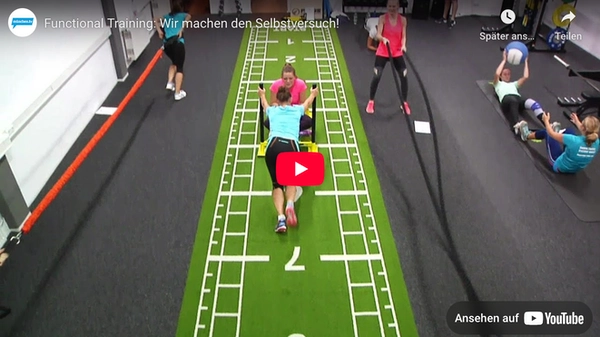
Thank you Anja for this informative video.
What functional training can I do with a personal trainer?
🧍♂️ Whole-body integration (Holistic Movement)
This component refers to exercises that work multiple muscle groups simultaneously and utilize complex movement patterns that involve multiple joints and muscle groups.
The focus is on functional movements rather than isolated exercises, which promotes overall body strength, flexibility and coordination .
👍 Movement Quality
The focus here is on the correct execution of movements to ensure efficiency and safety in training.
It is about training movements that are relevant to daily life and specific sporting activities.
This includes aspects such as balance, coordination, posture and motor control .
🏋️ Functional Strength (Functional Strength and Conditioning)
This area includes the training of strength, endurance and conditioning in a way that is aimed at improving performance in everyday life and in specific sports.
It also includes the scalability of exercises to adapt to different fitness levels and the prevention of injuries by strengthening the body in a holistic way .
Is my body functioning?
Why mobility training works better with a coach
Mental well-being:
Flexibility training also contributes to stress reduction and mental relaxation.
Concentrating on conscious movement has positive effects on mental balance.
-
Professional guidance and technology:
A qualified coach provides precise instructions on how to perform exercises correctly, which is crucial for the effectiveness of mobility training.
Incorrect technique is not only less effective, but also increases the risk of injury. -
Individual customization:
Every body is different, and a coach adapts training to the individual's specific needs, abilities and goals.
This includes recognizing and taking into account physical limitations or impending injuries. -
Motivation and accountability:
A personal coach not only provides support and encouragement, but also a sense of accountability.
Many people stay on track with their training and are more motivated to improve when someone else keeps track and keeps them motivated. -
More is not always better:
Too much training or too intense workouts without adequate recovery lead to overtraining and injuries.
It is important to know your limits. -
Experienceable and concrete:
A coach provides immediate feedback on your form and technique and makes corrections if necessary.
This feedback is crucial for understanding and learning the movement sequences. -
Holistic effect:
Targeted mobility training does not involve isolated approaches, but is part of a comprehensive fitness goal.
They also combine mobility training with other fitness goals, such as building strength, losing weight, or improving general physical abilities. -
Avoiding overload and injuries:
You need a coach to minimize the risk of overuse injuries and to ensure that exercises are performed correctly and with appropriate intensity.
Train your flexibility – benefit for a lifetime!
-
Injury prevention:
Regular flexibility training increases the flexibility of muscles and tendons, which reduces the risk of injury.
Especially in combination with other fitness components such as strength and endurance, it helps to increase overall body resilience. -
Improve posture:
Many flexibility exercises aim to balance the muscles, which leads to better posture.
This is especially important at a time when many people spend long hours sitting. -
Increased performance:
Improved flexibility will also improve performance in various sports and everyday life.
It allows for greater freedom of movement and helps movements to be performed more efficiently and effectively. -
Avoid one-sided training:
A holistic approach that includes different types of movement and muscle groups is much more effective than focusing only on certain areas. -
Maintaining independence in old age:
As we age, muscles and joints tend to lose flexibility.
Regular flexibility training helps to maintain mobility and thus independence in old age. -
Increase mobility:
This training not only means strengthening your muscles, but also improving your mobility and increasing your flexibility. -
Adapt the training individually:
Not every training style is suitable for everyone. Pay attention to your body's signals and adapt exercises to your individual needs.
Achieve goals in sports more effectively
With a personal trainer for mobility or functional training, you'll quickly get the hang of it. It's also great for group training!
Functional training not only strengthens the main muscle groups, but also the neglected stabilizing muscles and connective tissue.
In addition, it improves overall body control and balance, which is beneficial for almost any sport .
This enables athletes to react more quickly to unpredictable situations and reduces the risk of falls and injuries .
Functional training also promotes muscle strength and endurance, which is crucial for long-term performance and endurance in many sports.
By integrating cardiovascular elements into training, athletes are also able to improve their aerobic and anaerobic fitness, which is important for sports with high energy demands.
Finally, functional training supports physical regeneration and flexibility , which is essential for recovery after intensive training sessions and competitions.
Through stretching and mobility exercises, athletes maintain or improve flexibility, which contributes to better performance and a lower risk of injury.
Tips, myths and misconceptions about functional fitness
Tips:
-
Start with the basics:
Before you move on to more complex exercises, it is recommended that you start with the basic movements.
This includes conscious posture and an understanding of basic movement patterns. -
Technique before intensity:
Make sure you pay attention to the quality of the movement (not just the number of repetitions or the weight).
Concentrate on clean execution before increasing the load. -
Expertise in errors & progression:
Personal trainers know how to instruct exercises correctly, immediately recognize possible improvements in technique and thus help to avoid overload or injuries. -
Combine functional approach:
Incorporate both strength and mobility exercises into your training plan. - Personal trainer for functional training. Find the right functional training coach near you or online. Start now ✅
Myths & Misconceptions:
-
More is not always better:
Too much training or too intense workouts without adequate recovery lead to overtraining and injuries.
It is important to know your limits. -
Promoting body awareness:
Through flexibility training, you develop a deeper connection to your body, which improves awareness of posture and movement in daily life. -
Mobility training is more than just stretching:
It goes beyond simple stretching and includes a variety of techniques to improve the range of motion of your joints and muscle activity. -
Functional training is not just for athletes:
It is suitable for everyone, regardless of fitness level or sporting background.
It improves overall physical performance, which is beneficial at any age and at any stage of life. -
Functional training offers a wide range of workouts.
Building them up – whether with your own body weight or with special equipment – promotes the joy of fitness.
A long pain-free life!
Why you invest in your future with functional training
We've already mentioned the benefits, but here are the key points that illustrate why functional training is a valuable investment in your long-term health and well-being:
01. Adaptability for every fitness level
By simulating sport-specific movements, athletes can improve their technique, strength and coordination directly in relation to their athletic performance .
02. Increase mobility
Relief from pain and tension:
Regular stretching and flexibility training helps reduce muscle tension and stiffness, which is especially helpful for chronic pain such as back pain.
03. Injury prevention
One of the most important aspects of functional training is injury prevention.
By working specifically on strengthening your muscles and joints, you reduce the risk of injuries in everyday life or during sports.
04. Diversity and fun
Don’t expect quick results:
Many are looking for immediate improvements in their performance or mobility.
In reality, progress is often a slow, steady process.
05. Holistic health approach
Please remember that functional training is more than just physical fitness.
It also includes aspects such as balance, coordination and mental strength that contribute to a healthy, pain-free life.
06. Long-term benefits
Lay the foundation for long-lasting health and well-being.
Mobility training is a worthwhile investment in your future and provides you with the tools to stay active, healthy and mobile – regardless of what stage of life you are in.
 If there is no suitable trainer in the selection above, please use our search service.